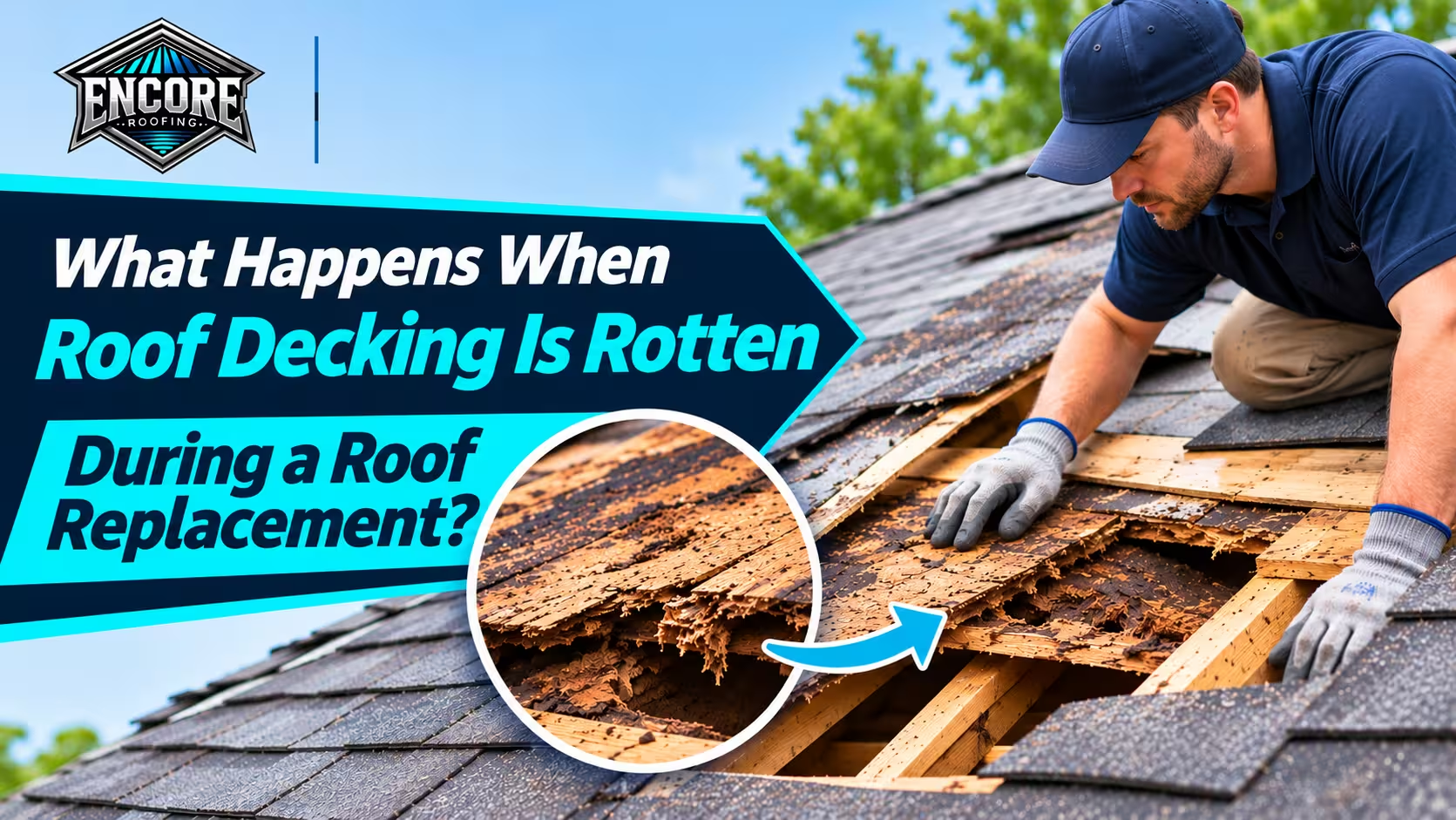
You booked a roof replacement expecting a simple swap. Then the tear-off starts, and the foreman waves you over to a dark, spongy patch of wood near the eaves. That wood is your roof decking, the solid layer everything else gets nailed into. Once it rots, it can’t anchor a new roof properly. Roof decking replacement is a normal part of many reroofing jobs, and it raises fair questions. This article explains how roofers spot the damage, what happens next, and how much decking usually has to come out.
What Is Roof Decking, and Why Does It Matter During a Roof Replacement?
Most homeowners never see their roof decking. Tear-off is the crew’s one real chance to check it. What they find decides whether the new roof goes straight on or needs carpentry first.
Think of an asphalt roofing system as a stack. Shingles sit on top, with underlayment beneath. Beneath the underlayment is the roof deck, a continuous layer of panels or boards attached to the roof framing. The roof rafters or trusses below carry the load, while the deck spans across them.
Many newer homes use plywood sheathing or oriented strand board, better known as OSB. Plywood is made by bonding thin wood sheets in alternating grain directions, while OSB uses compressed strands held together with resin. Older houses often have plank decking instead of either panel type. Nail-holding capacity is why the deck matters so much. Every shingle is held down by nails driven into that wood. Rotten wood lets them loosen or pull free when wind tugs at the roof.
How Do Roofers Identify Rotten Roof Decking After Removing Shingles?
Rotten wood beneath shingles often stays hidden until the old roof is gone. An exposed roof deck inspection finally shows what the view from the yard can’t.
Experienced roofers watch for these soft roof decking signs:
- Soft spots in roof sheathing that flex under pressure
- Dark staining or water marks on the wood
- Swollen or warped panels that sit unevenly
- Delamination, where plywood layers separate or OSB strands loosen
- Crumbling wood that breaks apart easily
- Fasteners that won’t hold
A decking inspection is more than a glance. Crews press on suspect areas and probe questionable wood. They watch for panels that bounce between rafters. Moisture intrusion often shows up near valleys and vents. A water stain does not necessarily mean the wood has rotted. A dark ring may mark an old leak that dried out long ago. Strength matters, not color. Ceiling stains or damp attic sheathing can warn of trouble early, but they rarely show the full picture.
What Happens When Roofers Find Rotten Decking During a Roof Replacement?
Covering rotten wood with new shingles is a bad trade. The roof looks finished for a while, but the weak spot keeps working against it. Here’s how roof decking replacement usually plays out.
1. The Affected Area Is Assessed and Documented
The crew lead marks every section, showing real structural deterioration. A soft patch near the gutter is a smaller job than rot running up a valley. Photos capture the hidden roofing damage before anyone cuts. The contractor should explain the findings to you before taking on extra work.
2. Rotten or Structurally Unsound Decking Is Removed
Rotted roof deck repair starts with a saw. Decayed wood can’t stay under a new roof because it won’t hold fasteners. Cuts often run past the visible damage until they reach solid material. They usually land over framing so the new piece has support.
Crews avoid nicking rafters or trusses while cutting. Badly decayed decking is also a fall-through hazard, so trained workers use fall protection. Homeowners should stay off the roof entirely. Panels with light staining but full strength stay put.
3. Suitable Replacement Sheathing Is Installed
Roof sheathing replacement means fitting new plywood or OSB that suits the roof. Thickness depends on rafter spacing and the existing deck. Local code and the shingle manufacturer’s instructions also shape the choice. The framing should support the panel ends, and the crew nails them off as the job requires. On older board decks, plywood replacement during reroofing may need shims to sit level.
4. The Repaired Deck Is Checked Before New Roofing Goes On
Nobody should roll underlayment over an unchecked repair. The crew looks for movement or raised edges and confirms every panel is fastened tight. Once the deck gives a flat, stable surface, the replacement picks back up.
Does All Roof Decking Need Replacement When Some Areas Are Rotten?
No. Finding rotten decking does not automatically mean the entire roof deck needs replacement. Damage often clusters around one leak point. Replacing those panels and leaving sound decking alone is localized roof sheathing replacement. It’s a very different job from redecking the whole roof.
Full redecking makes sense when rot is spread across many sections or repeated moisture has caused widespread delamination. Old board decks with wide gaps or sags may also qualify. The deciding factor is how much sound material remains.
Rafters need their own look. If decay has reached the roof rafters or trusses, new plywood won’t fix that. A roofer may then recommend having a structural engineer or another qualified professional evaluate the framing.
What Causes Roof Decking to Become Soft or Rotten?
Water does the damage, given enough time. Trouble starts when moisture keeps coming back or never dries out.
Roof deck water damage usually traces back to:
- Long-term leaks through worn shingles or failed flashing
- Water entering around vents and penetrations
- Ice dams forcing meltwater into the roof assembly
- Condensation building up inside the assembly
- Ventilation or moisture problems that keep wood damp
- Small leaks left alone too long
Wet wood swells and stresses the panel. Plywood layers separate and OSB strands lose their bond. With steady dampness, wood decay leaves crumbling, water-damaged roof boards. Poor ventilation can contribute, but it isn’t automatically the culprit. New panels fix the damage, so the moisture source needs its own fix.
Can New Shingles Be Installed Over Damaged Roof Decking?
New shingles should not be installed over decking that is too deteriorated to provide proper support and fastening. Shingles depend on the deck to stay flat and attached. Weak decking undermines the nails first. Fasteners in rotten wood can’t build enough grip, so wind lifts shingles more easily. Soft areas can also sag into dips that hold water.
A technical advisory from IIBEC (the International Institute of Building Enclosure Consultants) stresses replacing moisture-damaged substrate and deck materials during roof work. It mainly addresses low-slope systems and isn’t a residential shingle code. The principle still applies: fix what’s unsuitable, not every panel.
How Should Additional Roof Decking Replacement Be Documented?
Hidden damage can change the job. Rotten decking found after tear-off may add material and labor, and contract terms for that vary.
Good documentation usually follows this order:
- The contractor shows you the affected areas in person or through photos.
- The added material and labor are described in plain terms.
- A written change order spells out the extra scope and charges.
- You approve the change before work proceeds, as your contract allows.
- The contractor tells you whether the schedule shifts.
If rain is coming, a crew may need to cover the exposed area first to keep the house dry. Picture a crew stripping a ranch home and finding three soft panels below an old vent leak. The foreman texts the homeowner with a short change order. Once the homeowner signs off, the crew swaps the panels and goes back to shingling.
Frequently Asked Questions
How Do Roofers Identify Rotten Roof Decking?
They inspect the exposed deck after tear-off. Soft spots and swelling are common clues. Delamination and crumbling wood are clear warning signs too. A stain alone doesn’t condemn a panel.
Can New Shingles Be Installed Over Damaged Plywood?
Not if the plywood is too weak to support the roof or hold fasteners. Damaged plywood roof decking should be replaced first.
Does All Roof Decking Need Replacement During Reroofing?
Not necessarily. Limited damage usually means replacing only the affected sections. Full decking makes sense when deterioration is widespread, or the deck can’t support a new roof.
What Causes Roof Decking to Become Soft or Rotten?
Prolonged moisture is the cause. Slow leaks through damaged shingles or flashing are common sources. Ice dams and condensation can play a part too.
Can Rotten Roof Decking Be Discovered Before Shingles Are Removed?
Sometimes, partly. An attic inspection may reveal stained or damp sheathing from below. Ceiling stains can also hint at trouble. Plenty of damage stays hidden until tear-off exposes the deck.
How Should Additional Decking Replacement Be Documented?
Start with photos of the damaged areas and a clear note of their location. The contractor should list the added material and labor with the cost in a written change order. Homeowners should review and approve it as their contract outlines.
Final Thoughts
Rotten decking can’t be ignored during a roof replacement. A new roof needs solid wood to hold its nails and keep its shape. Sections that can’t provide that support should be replaced first. How much comes out depends on what the crew finds once the deck is bare. Encore Roofing, LLC handles roof replacement, installation, and inspections for homeowners in Newport, Harrisburg, Mechanicsburg, Perry County, and nearby Central Pennsylvania communities. If a new roof is in your plans, reach out to Encore Roofing to talk through your roof’s condition and the work it may need.